
Most business books I read once and shelve. A few I keep coming back to. Peter Senge’s The Fifth Discipline is one of the few.
It came out in 1990. I didn’t read it to run a consulting firm — I read it years before that, as an engineer at big companies trying to understand why smart people in well-run organizations kept getting bad outcomes. It stuck. And the longer I’ve worked, the more I’ve watched its ideas play out in real rooms with real teams.
Here’s why it still matters to me — and the one idea I’d hand to anyone leading a team today.
The short version
- Senge’s whole argument is that organizations have learning disabilities — built-in patterns that keep smart people from seeing what’s actually happening.
- The cure is five disciplines, and the one that ties them together is systems thinking: seeing the whole instead of your slice of it.
- The disability that hits hardest — “I am my position” — is everywhere, and it’s usually invisible until something breaks.
- It’s a slow read with a long shelf life. I still use its language to describe problems I see every week.
The five disciplines
The spine of the book is five disciplines a “learning organization” has to practice:
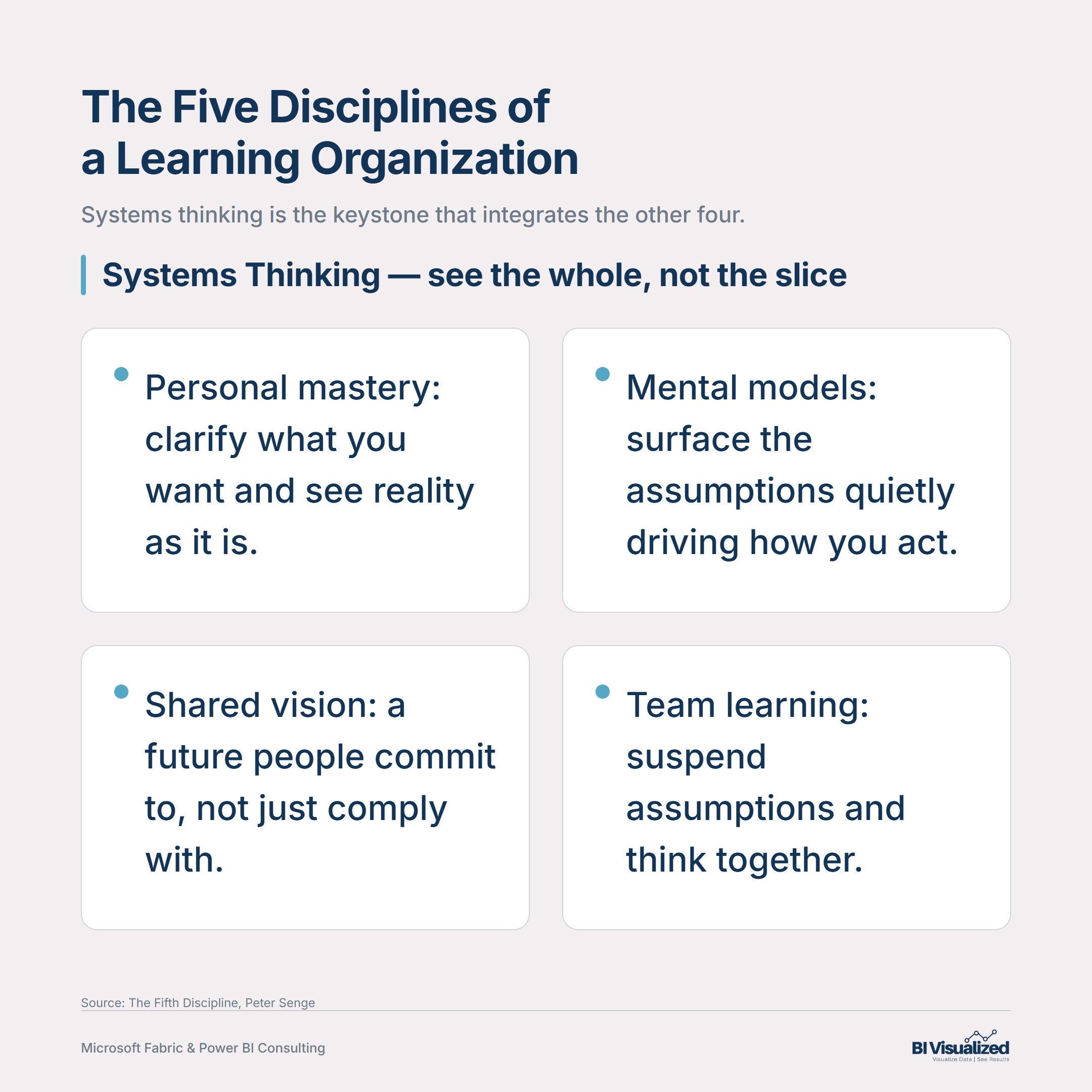
- Personal mastery — continually clarifying what you actually want and seeing reality as it is, not as you wish it were.
- Mental models — surfacing the deep assumptions you don’t know you’re carrying, because they quietly drive how you act.
- Building shared vision — a picture of the future people are genuinely committed to, not just complying with.
- Team learning — the capacity of a group to suspend their assumptions and actually think together.
- Systems thinking — the fifth discipline, the one that integrates the other four. Seeing the whole structure, not just the events on the surface.
What makes it more than a list is the claim that the fifth one is the keystone. Shared vision gives you the commitment to stay with hard problems. Mental models give you the honesty to admit your current view is incomplete. Team learning gets a group past individual perspectives. And personal mastery supplies the motivation to keep learning how your own actions ripple outward. Pull systems thinking out and the other four don’t add up to much.
The disability I see most: “I am my position”
Senge lists seven organizational “learning disabilities,” and the first one is the one I notice constantly.
“I am my position.” People come to see themselves as their job — an inconsequential part of a system they have little influence over — so they narrow their attention to the tasks right in front of them. When the whole enterprise underperforms, nobody can say why, because everyone was busy doing their part correctly. The failure lives in the spaces between the positions, where no single person was looking.
I’ve watched this one play out more times than I can count. Every department is doing its job. Every report is “right.” And yet leadership can’t get a straight answer to a simple question, because the answer lives in the seams between the positions — and nobody owns the seams.
The other disabilities rhyme with it: “the enemy out there” (the problem is always someone else’s fault), the fixation on events (we react to the dramatic spike and miss the slow drift that actually kills us — Senge’s boiling frog), and the delusion of learning from experience (we never see the consequences of our biggest decisions because they play out somewhere else, much later).
The laws that have aged the best
There’s a section he calls the Eleven Laws of the Fifth Discipline. A few have lodged permanently in how I think:
- Today’s problems come from yesterday’s “solutions.” The quick fix that worked last year is often the root of this year’s mess.
- The harder you push, the harder the system pushes back. Force a number up in one place and the system quietly compensates somewhere you’re not watching.
- Cause and effect are not closely related in time and space. The thing causing your pain today probably happened a while ago, somewhere else entirely.
- Small changes can produce big results — but the areas of highest leverage are often the least obvious. The fix that matters is rarely the one everyone’s arguing about.
That last one is the whole game. Most effort goes to the loudest symptom. The leverage is usually somewhere quiet.
The leader’s job, reframed
The part that’s aged best for me is how Senge reframes leadership. Not the hero at the front — three quieter roles:
- Designer — willing to experiment, break the mold, and build the conditions for others to contribute, rather than supplying every answer.
- Teacher — inviting people into a space made for learning, in service of them.
- Steward — serving a larger purpose; deciding what to conserve as much as what to change, and keeping the original intent in view.
It’s a humbler picture of leadership than the one we usually celebrate, and I think it’s the more honest one.
Why it still shapes how I work
I came up as an engineer. Systems thinking is native to that world — you learn fast that you can’t fix a system by staring at one component. Senge took that instinct and gave it language for organizations, not just machines. That’s why the book stuck.
And it turns out to be exactly the lens I bring to the work I do now. When a leadership team can’t get one trustworthy number, it’s almost never because a single report is broken. It’s “I am my position” wearing a spreadsheet — every group measuring its own slice, no shared picture of the whole. The fix isn’t a prettier dashboard. It’s helping the organization see the whole together. Senge’s words, written long before anyone was arguing about data platforms, but they fit.
Your turn
Next time something in your organization isn’t working, try resisting the urge to name the symptom. Ask instead: what’s the system producing this? The answer is usually quieter, slower, and further away than the thing you were about to blame.
If you’ve read The Fifth Discipline, I’d love to know which idea stuck with you. And if your team is wrestling with the “everyone has their own number” version of this, that’s the kind of problem we like — happy to talk it through.
— Jake Prevost, BI Visualized | Microsoft Fabric & Power BI Consulting

